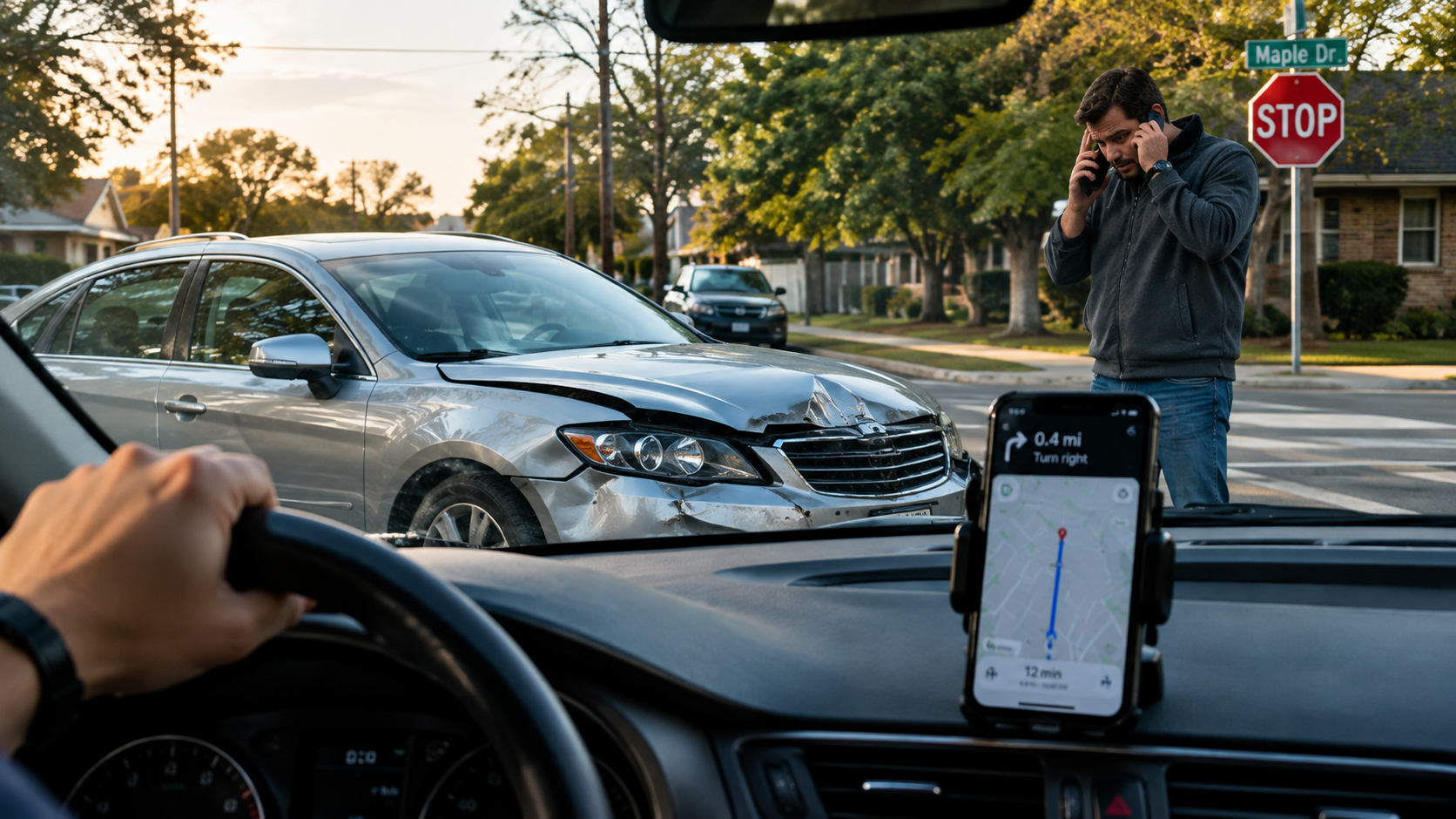
Driving for Uber or Lyft is a popular way to earn income, but operating without a dedicated rideshare insurance endorsement carries massive legal and financial risks. Many rideshare drivers assume that either their personal car insurance policy or Uber’s corporate coverage will automatically cover them in the event of a crash.
Unfortunately, thousands of drivers discover the harsh reality only after an accident occurs: a total gap in coverage that can lead to denied claims, personal lawsuits, and canceled policies.
In this article, we explain exactly what happens during a crash without a rideshare rider, how Uber’s coverage phases work, and how to protect yourself from financial ruin.
The Core Problem: The Personal Auto Insurance Exclusion
Every standard personal auto insurance policy in the United States contains a strict business-use exclusion (often referred to as the public or livery conveyance exclusion).
The moment you log into the Uber driver app with the intention of accepting passengers, your vehicle transitions from personal use to commercial use. If you have not added a rideshare endorsement to your personal insurance policy, your provider considers any business driving an un-insurable violation of your contract.
What Happens During an Accident: Phase-by-Phase Breakdown
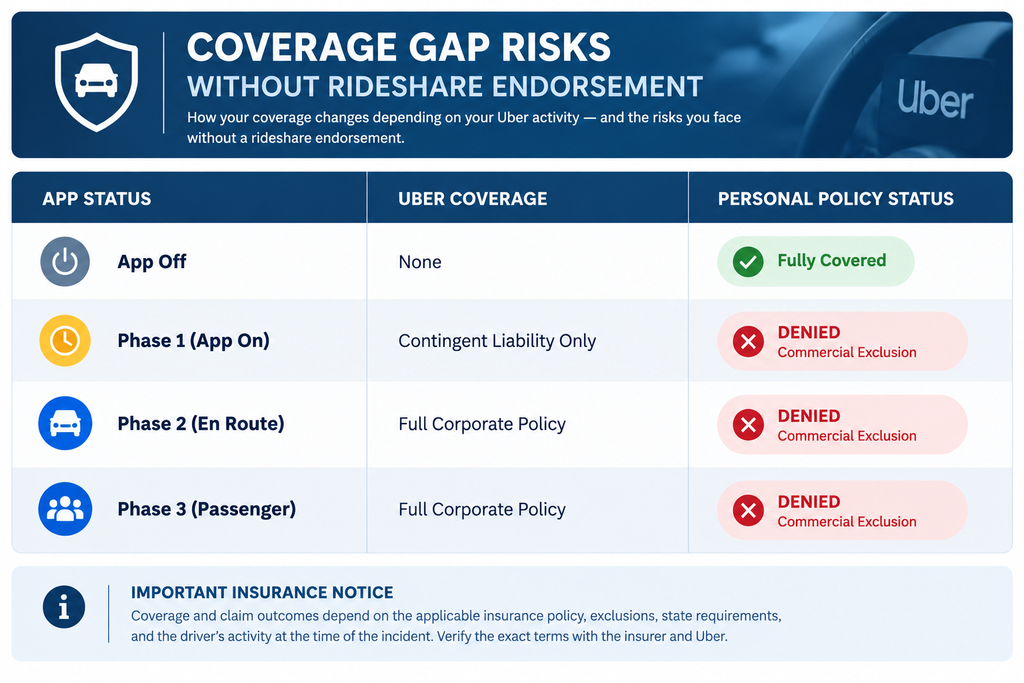
Uber’s insurance coverage changes depending on what stage of the ride you are in when the crash happens. Here is what occurs if you do not carry your own rideshare add-on:
1. Phase 1: App is ON, Waiting for a Ride Request (The Dead Zone)
This is where drivers face the highest personal risk.
- Uber’s Coverage: Uber provides low contingent third-party liability coverage ($50k bodily injury per person / $100k total / $25k property damage). However, Uber provides ZERO physical damage coverage for your own vehicle during Phase 1.
- Your Personal Policy: Denies your claim completely because the app was active.
- The Result: If you damage your car during Phase 1 without a rideshare rider, you must pay for 100% of your vehicle repairs out of pocket.
2. Phase 2 & 3: Ride Accepted or Passenger in the Car
During Phase 2 (driving to pick up a passenger) and Phase 3 (transporting the passenger), Uber provides $1,000,000 in commercial liability coverage and physical damage coverage for your vehicle. However:
- The Catch: Uber’s comprehensive and collision coverage carries a massive $2,500 deductible.
- Personal Policy Response: Your personal insurance provider will refuse to help pay down that $2,500 deductible because you were engaged in commercial driving.
Consequences of Getting into a Crash Without Rideshare Insurance
If you get into a collision while driving for Uber and fail to disclose or maintain rideshare coverage, you face several immediate consequences:
- Claim Denial for Property Damage: Your personal insurance company will issue a formal denial letter refusing to pay for repairs to your vehicle.
- Policy Cancellation or Non-Renewal: Insurers often drop policyholders immediately upon discovering undisclosed rideshare driving due to risk misrepresentation.
- Personal Liability Lawsuits: If you cause an accident in Phase 1 and damages exceed Uber’s low contingent liability limits, injured third parties can sue you directly for medical bills and property damage.
- Permanent Record in CLUE Database: Insurance claim denials and policy cancellations are recorded in the Comprehensive Loss Underwriting Exchange (CLUE) database, making your future insurance rates significantly higher with all carriers.
Will Your Insurance Company Find Out You Were Driving for Uber?
Yes. Do not assume you can hide rideshare driving from an insurance adjuster. Insurance investigators routinely verify app activity after an accident through several methods:
- Police Reports: Police officers routinely record passenger presence or rideshare stickers (trade dress) in the official accident report.
- App Data & Timestamp Requests: Insurance adjusters can request cell phone logs or app verification directly from rideshare companies during fraud investigations.
- Vehicle Inspection: Adjusters look for phone mounts, trade dress decals, or high annual mileage inconsistent with standard personal use.
How to Fix the Gap: Get a Rideshare Endorsement
The good news is that securing proper protection is surprisingly affordable. A rideshare endorsement (add-on) attaches directly to your existing personal auto insurance policy.
- What It Does: It bridges the gap during Phase 1 (providing physical damage coverage for your car) and lowers your deductible exposure during Phases 2 and 3.
- Average Cost: Adding a rideshare endorsement typically costs only $10 to $30 per month extra on top of your standard premium.
- Top Providers: Companies like Progressive, State Farm, Allstate, and GEICO offer specialized rideshare riders in most U.S. states.
Frequently Asked Questions (FAQ)
Is Uber’s $2,500 deductible covered by rideshare insurance?
Yes. Many rideshare endorsements include deductible gap coverage, which lowers your out-of-pocket deductible from Uber’s $2,500 down to your personal policy’s deductible amount (e.g., $500).
Can I just buy commercial auto insurance instead?
Yes, a full commercial auto insurance policy will cover rideshare driving 24/7 with comprehensive protection, but it is significantly more expensive ($200+ per month) compared to a simple rideshare endorsement.
Does rideshare insurance cover food delivery apps like UberEats or DoorDash?
Some companies bundle Uber rideshare and food delivery into one endorsement, while others require separate add-ons. Always check with your agent to ensure both passenger transport and food delivery are covered.
Conclusion & Action Steps
Driving for Uber without a rideshare insurance endorsement is a high-risk gamble that can cost you thousands of dollars in vehicle repairs or legal liabilities. To keep yourself protected:
- Contact Your Current Insurance Provider: Ask if they offer a rideshare endorsement in your state.
- Be Honest About App Use: Disclosing your rideshare driving prevents claim denials and keeps your policy valid.
- Shop Around: If your current insurer does not offer rideshare coverage, switch to a provider like State Farm or Progressive that supports gig drivers.